
Our Rules
Here are the rules we have, and why we have them

You do not talk about Korriban Society
You do NOT TALK about Korriban Society
You’ve all seen the holovid. A bunch of disaffected men, who feel like they no longer have a place in society, meet in the basement of a diner each Monday night, and they fight with one another. Before the fight, the leader, Tyler Durden, explains the rules of the club. The first two of those rules are also shared by our society.
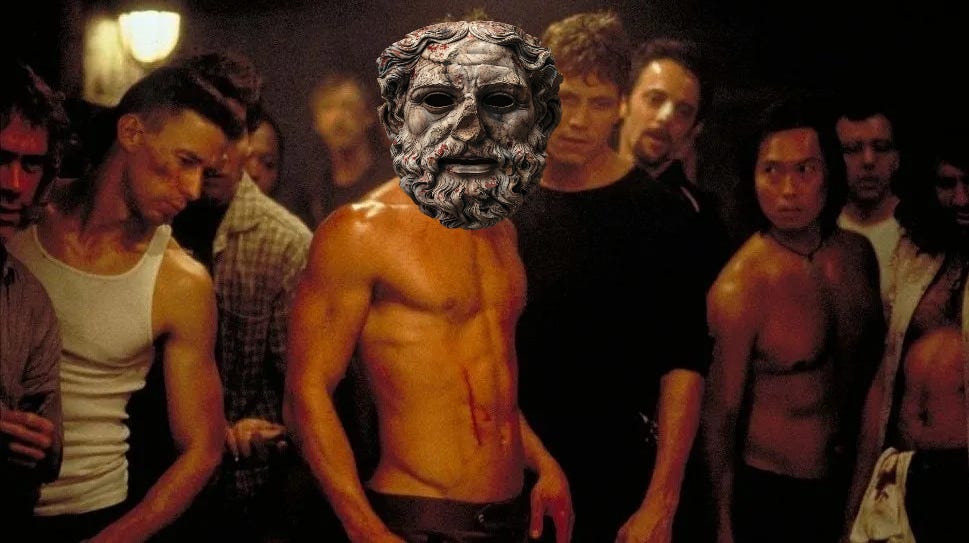
You do NOT TALK about the Korriban Society. For reasons that somewhat overlap with those of Fight Club.
First of all, there’s the tragedy of the commons to think about. The more people are involved in it, the worse it becomes. That, of course, will no doubt raise the question: “But Aristysus, if we’re not supposed to talk about it, why are you putting up videos on the holonet where everyone can see?” Well, many hands make light work. But not everyone that we can persuade to work on our behalf needs to know about the Society. In fact, in many cases, it would be better if they didn’t. Plus, you don’t need to be part of the Society to help us, or to benefit from the knowledge we offer.
Second, when you join the Korriban Society, there is a ceremony. “Darth Aristysus” is my true name, though not my legal name. My legal name became an alias when Darth Vivalous inducted me. If you’re committed enough to join us, you will leave your name behind in favor of whatever Vivalous or I give you.
Third, if our goals are to be realized, we need people to take us seriously. Nobody outside of the Society would take me seriously if I introduced myself as “Darth Aristysus”. Not at church, not at the supermarket, and certainly not at city council meetings. Not everyone is in on the kayfabe.
Fourth: Much of what I tell you is what Vivalous tells me, but with far more brevity. Even if you somehow managed to explain to someone what I tell you here in one sitting–I think it’s impossible, but I’d be impressed if you succeeded–they’d find our goals abhorrent. That’s just how deep the subversion has gone, and that’s how much farther our counter-revolution will need to go.
When out in public, hide your power. Do NOT talk about Korriban Society.
No fighting other Society members.
The third rule of the Korriban Society is: No fighting other Society members. If you have issues with another society member, avoid them until you resolve them.
You’d think this rule would be obvious, but it sadly isn't. The fact that more Sith have died on the lightsabers of other Sith than any other way is the greatest failing of our creed, and was the entire reason Darth Bane instituted the Rule of Two.

If you saw the introductory holovid, you know that we at the Korriban Society reject the Rule of Two. While it did greatly curb the Sith tendency toward infighting, it also greatly hampered the ability of Sith to act. Bane and his apprentice Zannah achieved little in their lifetimes besides the destruction of one of the largest Sith enclaves the galaxy has ever seen. They had no capacity to organize or wield political power. This did not change when Zannah supplanted Bane and took her own apprentice, Darth Cognus. Nor did it change with Cognus and her apprentice. This, by and large, was the pattern throughout the history of Sith abiding by the Rule of Two. The first time any noticeable effect was seen was when Darth Plagueis, a well-connected financier, took on a young Naboo statesman as his apprentice, and that statesman later became a Senator. In other words, Plagueis got lucky. Well, for a little while.
Sidious, Plagueis’s apprentice, played fast and loose with the Rule of Two, and as such was able to accomplish a lot more. What did Sidious in was building his legacy on lies to his apprentices, pitting them against one another, and never keeping any of the promises he made to them, until finally, his last apprentice stood up and overthrew him, but lost his life in the process.
By discarding the Rule of Two, we can delegate on a far greater scale than previous Sith. Sadly, infighting has long been a feature of Sith life, and has been our greatest weakness next to the Jedi, who have seldom fallen victim to such self-destructive behavior. At the same time, we know better than to pretend that all Sith are our allies. There are, without doubt, more than a few Sith involved in the subversion of the Republic for their own self-serving reasons. Unless they’re willing to abandon their cause, those Sith are not our allies. But those in the Society are, as are any others who will take up their lightsabers for the Republic and its ideals.
We being fallible beings, disagreements, and even heated ones, are bound to rise. As long as those disagreements do not conflict with our ideals or with the Society’s goals, they must not be allowed to hamper our cause. Should you find yourself in such a disagreement with a fellow Society member, then until you can resolve it, you must avoid them whenever possible. Keep your focus on your own tasks.
No fighting other Society members.
Do not ask permission to implement your projects. Just do them.
As I mentioned in the previous rule’s explanation, one of the greatest strengths the Jedi Order have had over the Sith is their unity, which gave rise to millennia of tradition and order. However, this is actually a weakness in disguise.
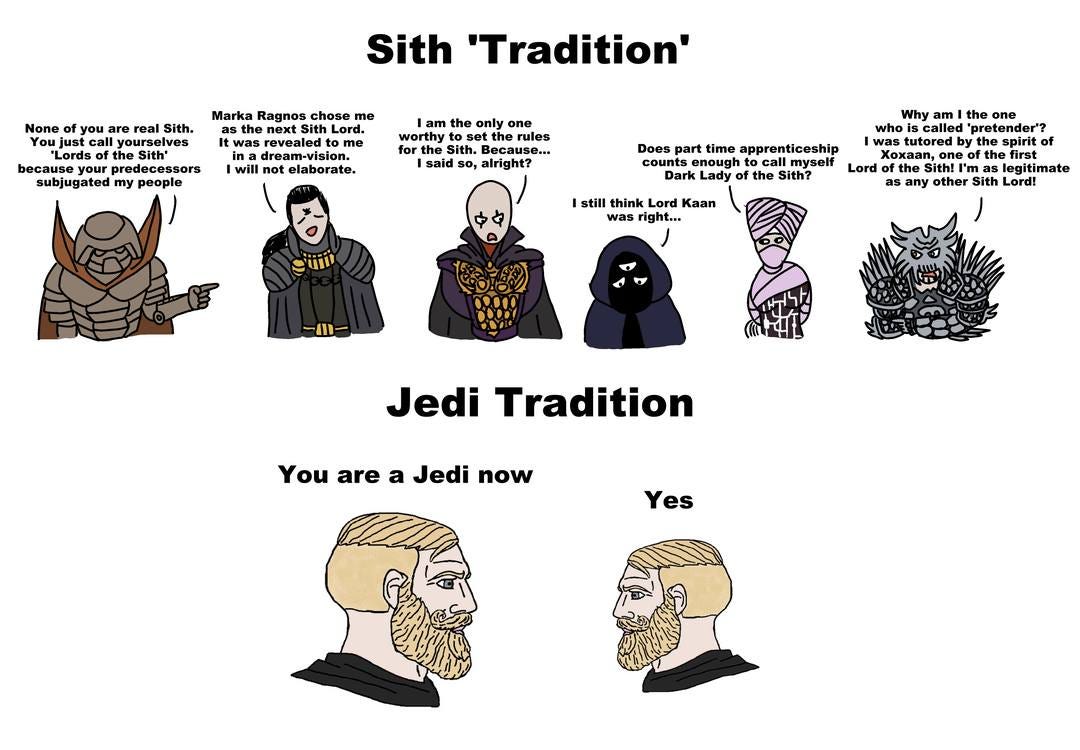
Consider the late history of the Jedi Order: Putting aside the general atmosphere of decadence and complacency that pervaded the Republic at the time, it wasn’t terribly difficult for Darth Sidious to infiltrate and subvert them. First of all, he was able to hide his affinity for the Force, which took suspicion off him. Secondly, the Jedi Order had many thousands of years before sworn fealty to the Republic. Ultimately, they answered to the Senate. Once Sidious, in his guise as Supreme Chancellor Palpatine, had stacked the Senate with enough of those loyal to him, he was able to put enough limits on the Jedi to keep them from being a problem for him.
Though we have no records of him actually utilizing it to his advantage, there is a third inherent weakness of the Jedi Order that Sidious might have used: Its centralized command structure. Though Jedi Masters are often given autonomy on field assignments, they ultimately answer to the council rebuilt by Grand Master Skywalker. The problem here is that if subversives are able to get their ideas as far as the top of the Order, those ideas will spread throughout the Order galaxy-wide, and attempts to fight the subversion will be stamped out with the institution’s own tools.
That’s why the Korriban Society works on a largely decentralized model. We won’t demand approval for all of your projects. There’s no way to make sure every single word is in keeping with mine or Darth Vivalous’s principles. Besides, we wouldn’t want it that way. The only diversity that matters is diversity of opinion. At the same time, too great a diversity of opinion would dilute our message.
Though we are Sith, we still aim to pursue a policy of innocent until proven guilty. Still, subversion must be guarded against. If someone wishes to join us who has a history of Leftist agitation, they are allowed to participate, but they will work closely with a trusted member of the Society until they have proven the purity of their intentions.
As for what it will take to prove them? Sorry, trade secret.
But if you’re fully approved, don’t get trapped in the mire of bureaucracy. If you have a great idea for advancing our aims or getting sympathetic people on board, go through with it. Nobody knows what to expect from us counter-revolutionaries, and being interesting is our greatest strength.
Do not ask permission to implement your projects. Just do them.
You must own a pet
This rule is probably the one that makes the least sense for first-timers. What does owning a pet have to do with saving the Republic from Leftist subversives? Well, more than you realize.
One of the greatest mistakes of the old Jedi Order that was destroyed by Sidious was its strict–well, mostly strict (why did Ki-Adi-Mundi get a pass on everything?) ban on forming attachments. This was interpreted to mean no romantic relationships up to and including marriage, no contact with one’s birth family, no contact with children one may have birthed, no overly involved friendships, and no pets.
Let’s take a look at what exactly caused that Jedi Order to fall to Sidious. There were many factors, but the most immediate one was when Master Mace Windu, who already had a somewhat adversarial relationship with Anakin Skywalker, was thwarted in his attempt to arrest Palpatine, whom Skywalker had told him was secretly a Sith Lord. Skywalker, it must be remembered, was being secretly groomed by Sidious. At the same time, Skywalker was in a clandestine marriage with Padmé Amidala, Naboo’s Senator. Palpatine had so ingratiated himself to Anakin, he had an easy time manipulating him into telling him about his marriage. Then, he planted the idea in Anakin’s head that his wife was likely to die giving birth to the twins she was pregnant with, and that only he could save her, with secrets known only to Sith. This was, of course, a lie, but it was enough to make Anakin more pliable to Palpatine’s influence.
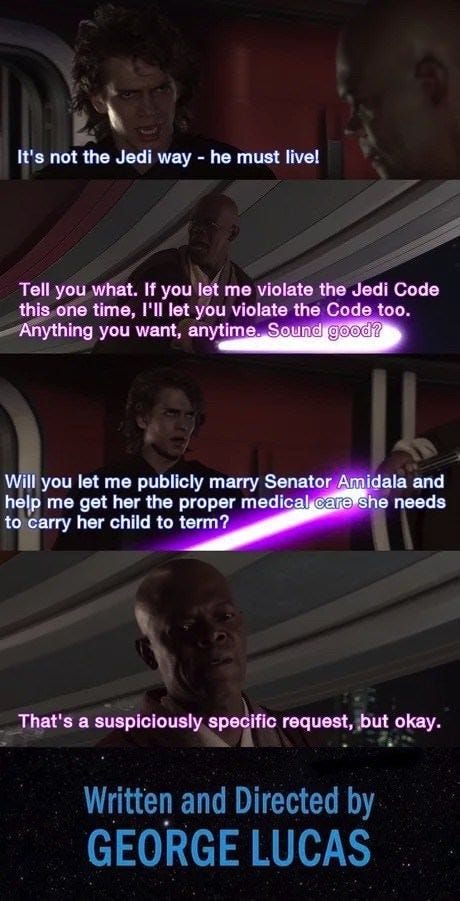
Now, there is a lot of speculation about how this could have gone differently. Perhaps Master Windu could have offered Anakin a quid pro quo deal to allow him to kill Sidious without trial. Perhaps Anakin’s Master, Obi-wan Kenobi, could have told the truth about knowing about Anakin’s relationship and made him come clean, keeping Anakin out of any sort of position where he could interfere with Sidious’s arrest. Perhaps Padmé could have convinced Anakin to leave the Jedi Order or turn against Sidious. But none of these happened. Why? Because Anakin valued both his allegiance to the Jedi Order and his wife too much to let go of either. Padmé was neither conniving nor power-hungry enough to try to convince Anakin to usurp Sidious. Nor did Anakin trust anyone in the Order, even his own Master, to tell him about Sidious’s offer to him, for in doing so he would have exposed his secret marriage, putting his status as a Jedi in jeopardy.
But what if we go back to the root of all these problems, by which I mean, the Jedi Order’s ban on attachment? On its face, the rule makes some sense: Jedi must not grow too close to lovers, friends, pets, or other Jedi, lest they compromise their missions, or lest their loyalties become divided. If you think about it, though, this doesn’t wash.

We all crave attachment at some deeper level. Children naturally attach to their parents, and people seek attachment to lovers. The desire is always there, no matter how hard outside forces suppress it. While it’s perfectly reasonable not to want missions compromised, this can be avoided simply by having Jedi not take those they are attached to on their missions.
The Jedi Code is one that promotes serenity and rational discussion. Who better to help other Jedi manage romantic and family relationships? Had Anakin been permitted to marry Padme and stay a Jedi, perhaps Master Yoda could have promised the Order’s best healers to oversee the safe delivery of Padme’s twins. Perhaps Madame Jocasta or one of the other Jedi could have helped Anakin deal with the pain of losing his mother, or better yet, bought his mother’s freedom and given her an apartment on Coruscant, keeping her safe from Sand People abduction. This would have either resolved or prevented Anakin’s abandonment issues, making him less open to Palpatine’s manipulations.

That we all desire attachments is, as I said, something that cannot be changed. Nor should it be. None of us can navigate through the chaotic mess known as “life” alone. We need people we can know and trust, and pets are a great help since they love us unconditionally, and require our investment and love to survive. If you can handle the responsibilities of a pet and devote time to caring for it, you have the mindset necessary to understand everything the Korriban Society stands for and hopes to achieve.
You must own a pet.
This is pretty good stuff.
Best of luck.